Finding Wabi Sabi
A newfound perspective of hair from a barbering lens
I’ve been exploring the Japanese words “wabi-sabi” and their meaning. If you’ve heard these words before, you may have also heard it’s translation which, in loose definition, is to find beauty in imperfection. This idea has peeked my interest lately because it runs almost opposite to the way I was trained to see my work.
I was professionally trained to do hair in barber school, and the idea of imperfection in a barber’s mind is formidable. Barbering is all about precision, details, and being the fucking best at making imperfections appear to be nonexistent. We’re constantly reminded of the importance of pinpoint cutting, because short hair has a loud mouth and it will quickly expose your lack of skill and proficiency if you let it. That was the standard I was trained to work toward.
I’ve specialized in barbering for the last nine years. I am very proud of the work I produce. It’s recognized worldwide for looking flawless, effortless, and immaculate. I take major pride in that because producing brilliant work takes a lot of consistent effort, training, mistakes, and obsession to achieve. Maybe something that’s kept me going so long is the fight I have with myself to produce perfection. I know perfection doesn’t exist, but maybe it could if I did another haircut, and another, and another. Perfection is impossible, yet the details of barbering make you believe it isn’t. Unfortunately, details can only be seen through repetitive and recurring practice. Training your eye makes you better, but it also gives you more and more to notice, and that can become an addiction. I became addicted to the details because my eye was in training at a time that constantly gave it something impossible to compare itself to.
I came up in this craft during the start of Instagram and the hype of Photoshop. There were very few barbers who were widely known for their work, but if they were, their haircuts were shot on their DSLR at the highest resolution possible, then imported into Photoshop to tailor the shit out of their haircut, exported, and then imported to Instagram for posting. Looking back it is so obvious how modified their haircuts were, but at the time, the majority of people couldn’t see it for what it was - phony perfection. (Today Photoshop barbers have been replaced with barbers who use enhancements on every cut).
I bring up the Photoshop barbers because without them I really wouldn’t be as great as I am today. When I tell you I was comparing my real life haircuts to their excessively photoshopped haircuts every single day for years. I would take photos of my own work and see so many imperfections, I would study them like a football coach studies plays. I would then take more photos of my cuts and compare them to the last. The sad thing is, I knew the haircuts I was trying to create were reproduced by technology, and yet I would still used them as a benchmark for my own progress. Their fake perfection fed an unhealthy mindset in me. And this was when I became impregnated by perfectionism. Apart from wanting to outperform the photoshop barbers, there was more happening during this quest to be perfect; which ultimately enhanced this craze within me. And because I was entering the industry as a woman, it became even harder to let go of.
Entering this male-dominated industry as a female was DEEPLY challenging. Selfishly speaking, I never wanted to be the girl whose haircuts were below average because then I’d hear, “they only come to you because you're pretty.” Wouldn't you know, I still heard that even though my work was truly great for how novice I was. The most consistent backhanded compliment I received was, “you cut good for a girl.” I was constantly facing discrimination and dismissal from jealous male barbers, even when my fades were comparable to the photoshopped ones! And this is when I developed the need to prove myself through perfectionism. I thought, if only I could undoubtedly be the best barber in the shop, in the competition, or in online circles - then I would get the recognition, respect, and credibility I deserved. I’m here to tell you, I was/am all of those things, and still nothing has really changed. That was the lie of it: I thought being exceptional would make me impossible to overlook. But no amount of perfect work could control what other people chose to see.
In 2023, I started realizing that my perfectionist mindset was limiting my work. I began a new venture into working with longer lengths. I quickly saw that hairsplitting (lol) is kind of irrelevant and a waste of time. Long hair doesn’t ask for perfection, because it has the ability to hide error, unlike short hair. I remember closely examining the people teaching me, and I was utterly mesmerized by their high level skill paired with a lack of care (in a good way) and nitpicking as they worked. They weren’t trying to control every strand of hair. They gave permission to the person’s natural hair to participate in the result. It felt like art. It felt like breath. It felt like…wabi-sabi. It was then that I knew - this is legitimately so ironic - that in order to achieve and excel in this new way, I had to put aside the mindset that made me that artist I am, perfectionism. Talk about a full 180. First I learned to be perfect. Then I learned my perfectionism was actually holding me back.
Over the last couple years, I’ve been through very deep waters of transformation. It’s been hard, it’s been revealing, it’s been clarifying, but it’s ultimately making me a more complete artist. During this time, I saw myself chasing perfection for acceptance, and I hated that. Last September I said no more. I decided that I was done being held captive to perfectionism by one mistake, one imperfect detail, or one person’s opinion to become evidence that I was unworthy. I think naturally, as an artist, I’m anal as fuck. I prioritize structured aesthetics so hard. But I’m learning the beauty of wabi-sabi. I’m learning that order isn’t what makes life, things, and hair beautiful. It’s beautiful because it’s messy, it’s natural, and it’s error-prone. Beauty does not live in perfection, it cannot live in perfection, because perfection itself does not exist.
I’m really grateful to have learned this truth in my journey of being an artist. I’ve been able to offer this experience to my own students in hopes of furthering them sooner in their own careers. It’s allowed me to share the importance of breaking certain mindsets that can be restraining with aim to create more well-rounded artists - like understanding that the best work doesn’t always come from fixing every possible flaw, it can also come from knowing what to leave alone and appreciate.
What I’ve settled on is that aiming for perfection isn’t bad, but it also can’t exist alone. I think the best demonstration of skill is the ability to mix precision with play, both completely opposite of each other yet so complementary. Wabi-sabi helped me see that something can be beautiful, skillful, and intentional without being over-controlled or flawless. All in all, I’m not necessarily rejecting skill, standards, details (I loveeeeeee details), or excellence. I am rejecting the belief that every visible irregularity must be corrected, and that precision is the only form of skilled artistry.
-AB
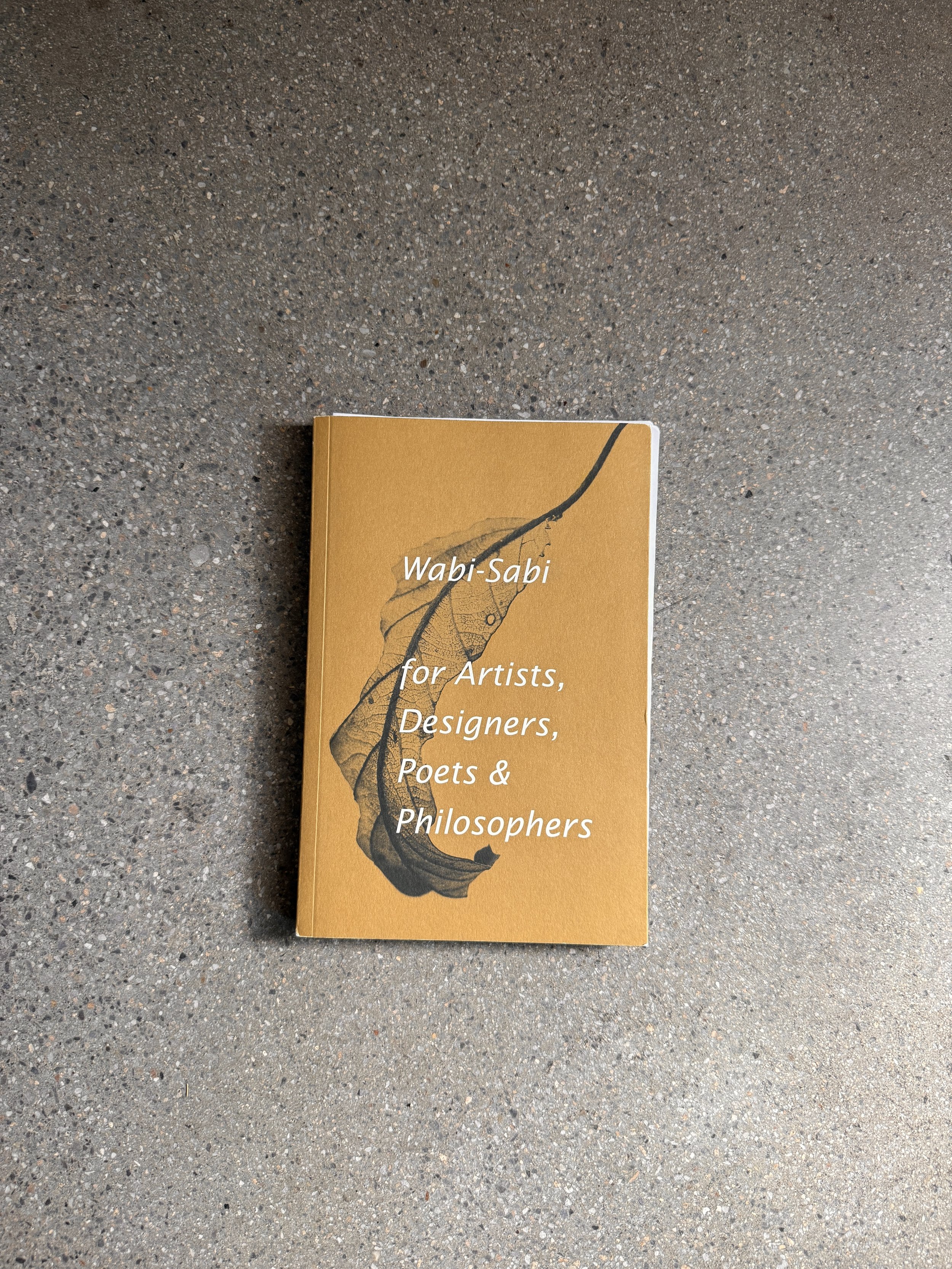
If you’re curious to learn more about
wabi
-sabi, I highly recommend this book.